European Federation

I think many of you have heard of the recent news about Hungarian elections - where authoritarian Orban was decisively defeated by Magyar - big plus for EU, even if he’s not a federalist himself, it’s a win for EU, and very likely an end to that constant vetoing of EU decisions. Orban’s vetoing reignited the question of EU integrating further and letting go of vetoes. This isn’t about any one leader, but about whether unanimity rules are still viable in a union of 27+ states.

Trump presidency’s shown to Europe that it cannot rely on USA endlessly. USA is now not only an unreliable partner, but increasingly acting like a hostile nation. A fragmented EU may play well into Russian and American cards, but not for Europeans. This furthers the question of European federalization, the need for common foreign policy and army. Recent events raise uncomfortable questions about whether the EU’s current structure is still fit for the geopolitical environment we’re entering.

I wonder how you view this, the push towards federalization (even if in tiers) and more unity, let’s take a vote and have a discussion.

EU and non-EU citizens, do you support European federalization?
  • Yes (EU citizen)
  • A very cautious Yes (EU citizen)
  • No (EU citizen)
  • I’m fine with either (EU citizen)
  • Yes (non-EU citizen)
  • A very cautious Yes (non-EU citizen)
  • No (non-EU citizen)
  • I don’t care, just show results
0 voters

How it might work

General outline

Below is a plausible, non-utopian, step-by-step scenario for gradual EU federalization, built around political reality rather than ideal theory. This is roughly how it could happen if driven by pressure, incentives, and asymmetric participation rather than grand constitutional moments.


1. The Core Driver: Federalization by Necessity, Not Ideology

The European Union does not federalize because people suddenly become federalists.
It federalizes because certain functions stop working otherwise.

The main pressure points:

  • Security & defense (Russia, instability, US unreliability)
  • Industrial & energy policy (competition with US/China)
  • Foreign policy credibility
  • Repeated veto paralysis

This creates a logic of functional consolidation:

“If we want X outcome, we need Y authority — even if we don’t love it.”


2. The Tiered Architecture (Concentric Circles Model)

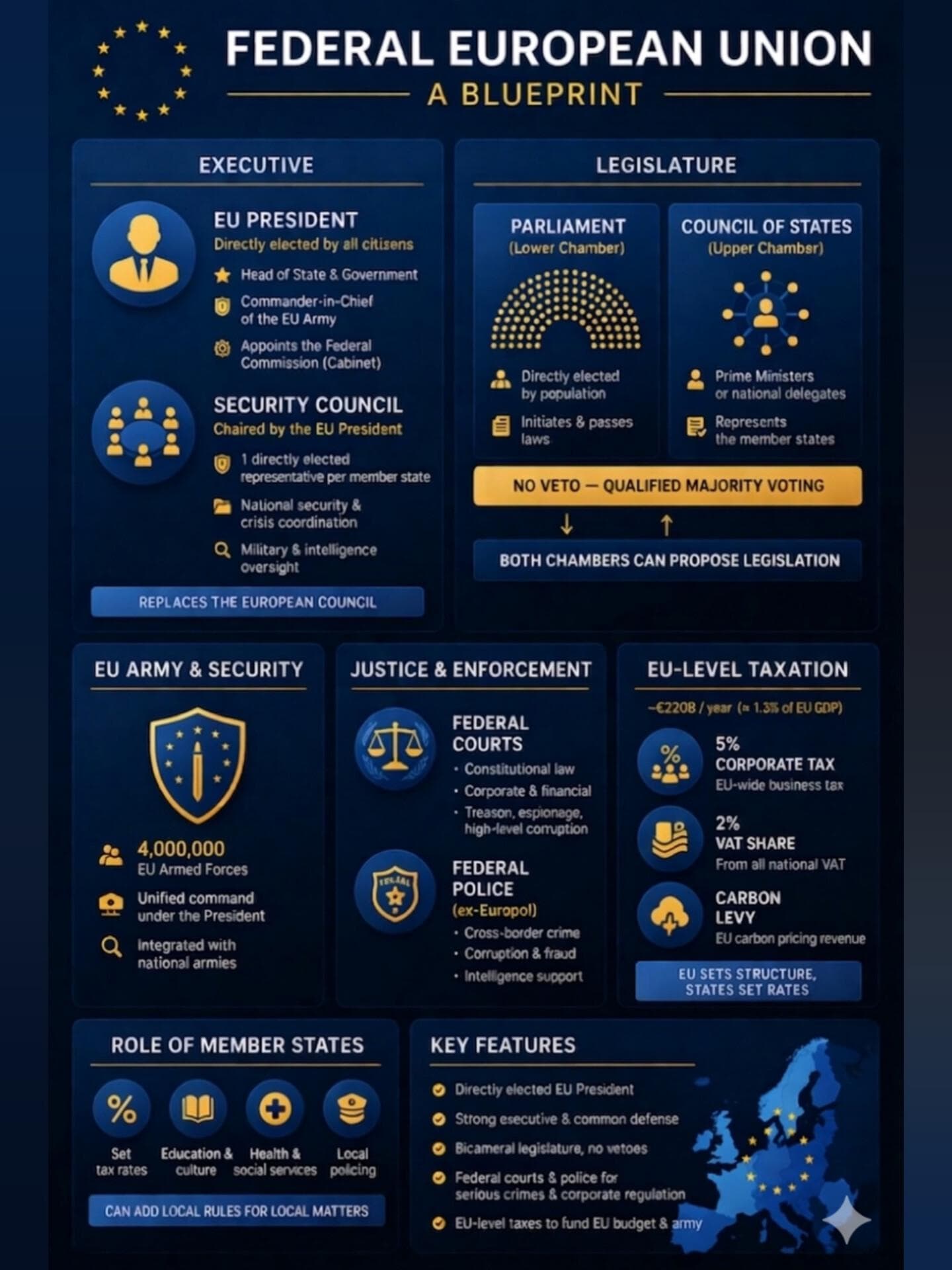
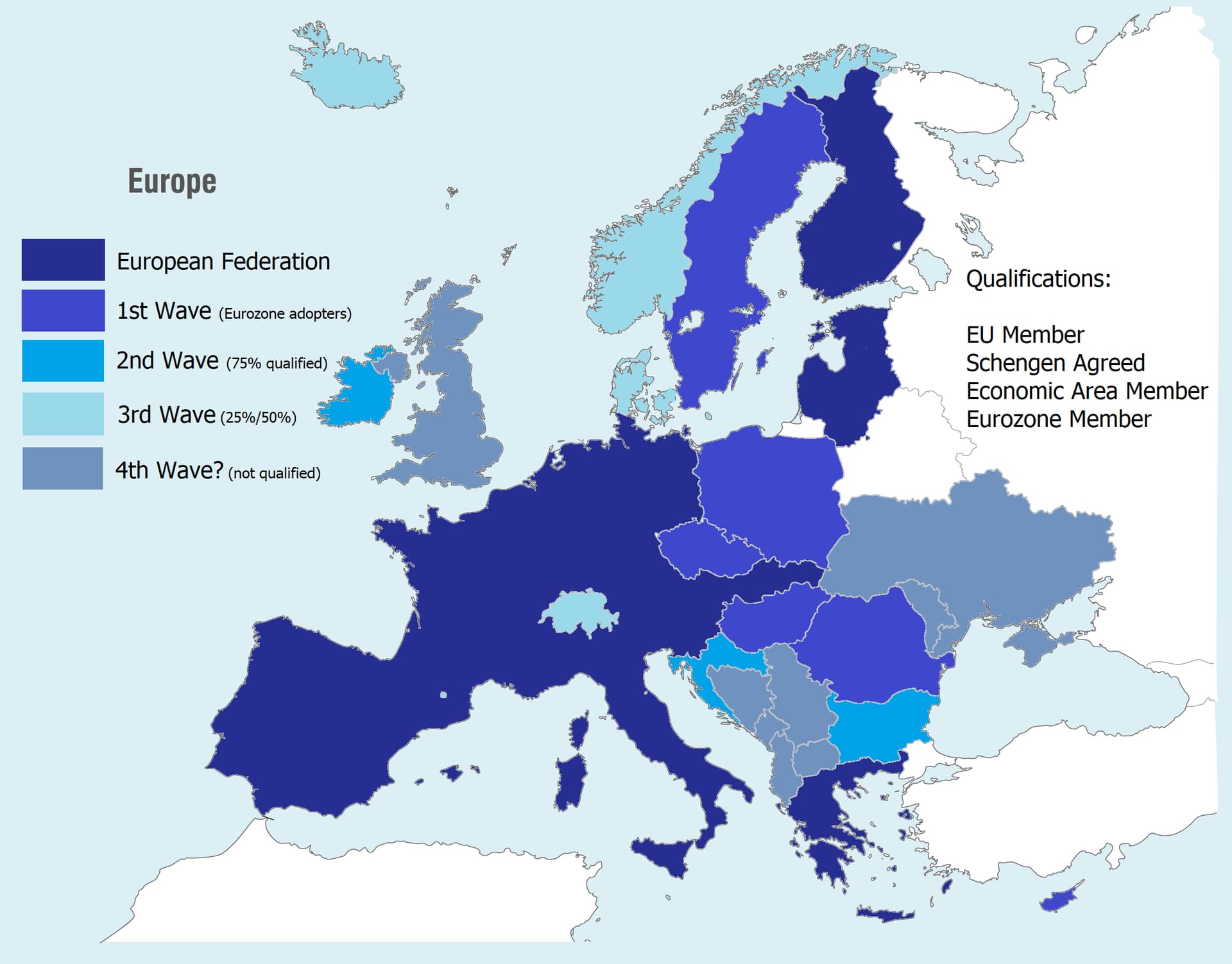
Tier 1: The Federal Core (≈ 8–12 states initially)

Who joins

  • States already aligned on:
    • rule of law
    • defense outlook
    • fiscal discipline
    • foreign policy direction
      (e.g. France, Germany, Benelux, Nordics, possibly Italy, Spain, Baltics, later others)

Competencies pooled

  • Defense & military procurement
  • Foreign policy representation
  • Sanctions & security decisions
  • Strategic industries (energy, semiconductors, defense)
  • Partial fiscal capacity (joint borrowing, defense budget)

Decision-making

  • No vetoes
  • Qualified majority or supermajority
  • Stronger executive coordination

Key political trick
This is not called a “federal state”.
It’s framed as a Defense and Strategic Union inside the EU treaties (via enhanced cooperation).


Tier 2: The Integrated Union (Most EU states)

What they keep

  • Single market
  • Free movement
  • Trade policy
  • Climate and regulatory alignment
  • Structural funds access

What they don’t get

  • No veto over Tier 1 decisions
  • Limited say in defense / foreign policy

This tier keeps countries like:

  • Poland (depending on government)
  • Czechia
  • Romania
  • Possibly Italy at times

They benefit economically but accept reduced blocking power.


Tier 3: The Associated / Peripheral Members

Includes

  • Eurosceptic states
  • Rule-of-law problematic states
  • States unwilling to pool sovereignty

Features

  • Market access (with conditions)
  • Reduced funding
  • No veto
  • Opt-outs from core policies

Politically, this tier:

  • Lowers internal sabotage
  • Avoids forced exits
  • Keeps the EU together without uniformity

3. How the Transition Actually Happens (Mechanism)

Phase 1: Crisis-Triggered Integration

A major external shock:

  • Security escalation
  • Energy crisis
  • US withdrawal from NATO guarantees (partial or perceived)

→ Emergency coordination becomes permanent.

Phase 2: Enhanced Cooperation Becomes the Norm

What’s currently “exceptional” becomes routine:

  • Joint procurement
  • Joint debt for defense
  • Standing EU military command (initially small)

Legal framing:

  • No new constitution
  • No referenda initially
  • Everything done within existing treaties

Phase 3: Institutional Reality Catches Up

Once the system functions federally, institutions adapt:

  • European Parliament sub-chambers for Tier 1
  • A European Security Council
  • Executive roles gain de facto authority

At this point, formal federalization becomes descriptive, not revolutionary.


4. The Main Challenges — and How They’re Tackled

Challenge 1: Democratic Legitimacy

Problem

  • “Who voted for this?”
  • Fear of technocratic overreach

Solution (gradual)

  • Dual legitimacy:
    • European Parliament (population)
    • Council of States (state equality)
  • Stronger national parliament oversight
  • Eventually: elections tied to Tier 1 competencies only

Key insight:
Democracy is added after functionality, not before.


Challenge 2: National Identity & Cultural Fear

Problem

  • Fear of erasure
  • Centralization anxiety

Solution

  • Explicit constitutional limits:
    • Culture, language, education remain national
  • Symbolic restraint:
    • No forced EU patriotism
    • No cultural homogenization narrative

Federalization is framed as instrumental, not civilizational.


Challenge 3: Economic Divergence

Problem

  • Rich vs poorer states
  • Transfer resentment

Solution

  • Conditional solidarity:
    • Funds tied to reforms
    • Defense/industry investment rather than pure redistribution
  • Core budget focused on public goods, not welfare

This keeps fiscal hawks on board.


Challenge 4: Spoilers & Internal Sabotage

Problem

  • States using vetoes for leverage
  • External influence

Solution

  • Veto power slowly confined to Tier 2/3 issues
  • Financial leverage replaces political confrontation
  • Rule-of-law conditionality enforced quietly, not theatrically

The EU learns to stop arguing and start bypassing.


5. What This Looks Like After ~20 Years

  • One EU passport, but multiple levels of political participation
  • A real European military exists, but isn’t universal
  • Foreign powers treat the Core as a single actor
  • The word “federal” may still be avoided — but the structure is federal in practice
  • Entry into the Core becomes a goal, not a right

Crucially:

The EU survives by accepting asymmetry, not by forcing unity.

Addressing lack of common mythos, corruption of the eastern states, and socio-ideological concerns ('wokeism', liberalism vs conservativism, etc.)

1. A Common European Mythos — Without Forcing It

First: what not to do

A common mythos cannot be:

  • mandated from Brussels
  • abstract (“values”, “norms”, “ever closer union”)
  • culturally homogenizing
  • framed as moral superiority

That approach backfires immediately and feeds Euroscepticism.

What does work: mythos by function + memory

The EU’s viable mythos is not “who we are”, but what we repeatedly choose to prevent and protect.

A plausible European mythos would be built around three pillars:

A. “Never Again, But Seriously This Time”

Not just WWII rhetoric, but:

  • war between Europeans is unthinkable
  • great-power subordination is unacceptable
  • internal decay is as dangerous as external enemies

This mythos is defensive, sober, non-triumphalist.

B. Europe as a Civilizational Balancer

Not hegemonic, not missionary, but:

  • resisting domination (whether Russian, American, or Chinese)
  • preserving pluralism inside strength
  • refusing ideological extremes

This is attractive even to skeptics because it avoids moral crusading.

C. Earned Membership, Not Moral Virtue

Belonging to the “core” is not about beliefs, but behavior and capacity:

  • rule of law
  • contribution to security
  • institutional seriousness

That creates aspiration, not resentment.

:pushpin: Key mechanism:
Mythos spreads via institutions that work, not slogans.

A shared defense, crisis response, border protection, disaster relief — these quietly generate loyalty over time.


2. “Stamping Out” Corruption in the East — Without Colonial Dynamics

This is extremely sensitive, but unavoidable.

The core mistake to avoid

Framing corruption as:

  • “Eastern backwardness”
  • moral failure
  • cultural deficiency

That narrative is both inaccurate and politically toxic.

The more accurate framing

Corruption is primarily a state-capacity and incentive problem, not a civilizational one.

Post-communist systems inherited:

  • weak institutions
  • politicized courts
  • informal networks replacing trust
  • sudden capital flows without enforcement capacity

How the EU can realistically reduce it

A. Shift from rule-policing to capacity-building

Instead of:

  • endless “rule of law” scolding
  • symbolic Article 7 threats

Move toward:

  • embedding EU-level prosecutors, auditors, and judges in joint institutions
  • EU oversight on specific funds, not entire states
  • automatic mechanisms, not political discretion

This makes corruption technically harder, not morally condemned.

B. Conditional Core Access

This is where tiers matter.

Access to:

  • defense industry contracts
  • strategic funds
  • decision-making roles

→ conditioned on:

  • prosecutorial independence
  • procurement transparency
  • judicial enforceability

No lectures. Just incentives.

C. Make Corruption Economically Costly, Quietly

The EU historically failed by:

  • tolerating corruption for stability
  • then exploding politically when it becomes visible

Instead:

  • silent fund suspension
  • automatic clawbacks
  • personal liability at elite levels

Corruption declines when it stops paying.


3. Reducing Over-Liberalism / “Wokeism” Without Reactionary Backlash

This is one of the least openly discussed but most decisive issues for EU legitimacy.

The problem

The EU increasingly appears as:

  • culturally detached
  • normatively maximalist
  • focused on symbolic virtue rather than material order

This alienates:

  • working classes
  • conservatives
  • much of Central/Eastern Europe
  • even moderate liberals

What not to do

  • Culture wars from Brussels
  • Imposing social policy harmonization
  • Framing dissent as moral failure

That creates permanent resistance.

What can work instead

A. Radical Institutional Neutrality on Culture

A federalizing EU must explicitly renounce cultural engineering.

That means:

  • no EU-level identity politics
  • no mandatory social ideology
  • no symbolic legislation without functional purpose

This reassures skeptics immediately.

B. Recenter on Order, Capability, and Limits

The EU regains legitimacy by focusing on:

  • borders
  • infrastructure
  • energy
  • defense
  • industrial resilience

When institutions deliver order, culture wars lose oxygen.

C. Subsidiarity With Teeth

Culture, family law, education → explicitly national
Not “in practice”, but constitutionally protected

This allows:

  • liberal societies to remain liberal
  • conservative societies to remain conservative
  • cooperation without uniformity

Pluralism becomes structural, not rhetorical.


4. How These Three Threads Reinforce Each Other

Here’s the key insight:

Mythos, anti-corruption, and cultural restraint all depend on competence.

A Europe that:

  • protects borders
  • deters threats
  • punishes corruption quietly
  • avoids ideological overreach

…does not need forced narratives.

Legitimacy emerges after order and effectiveness.


5. The End State (If This Succeeds)

After ~20–30 years:

  • A quiet European identity exists, but is not loudly proclaimed
  • Corruption hasn’t vanished, but is structurally constrained
  • Cultural battles happen nationally, not at EU level
  • The EU is respected more than loved — and that’s enough
  • Federalization is accepted because it works, not because it is “right”

In short:

Europe survives not by becoming more virtuous, but by becoming more serious.
Multiple tiers and waves, similar like this (while the exact list of members might differ)
More resources: https://www.youtube.com/@EUMadeSimple/featured

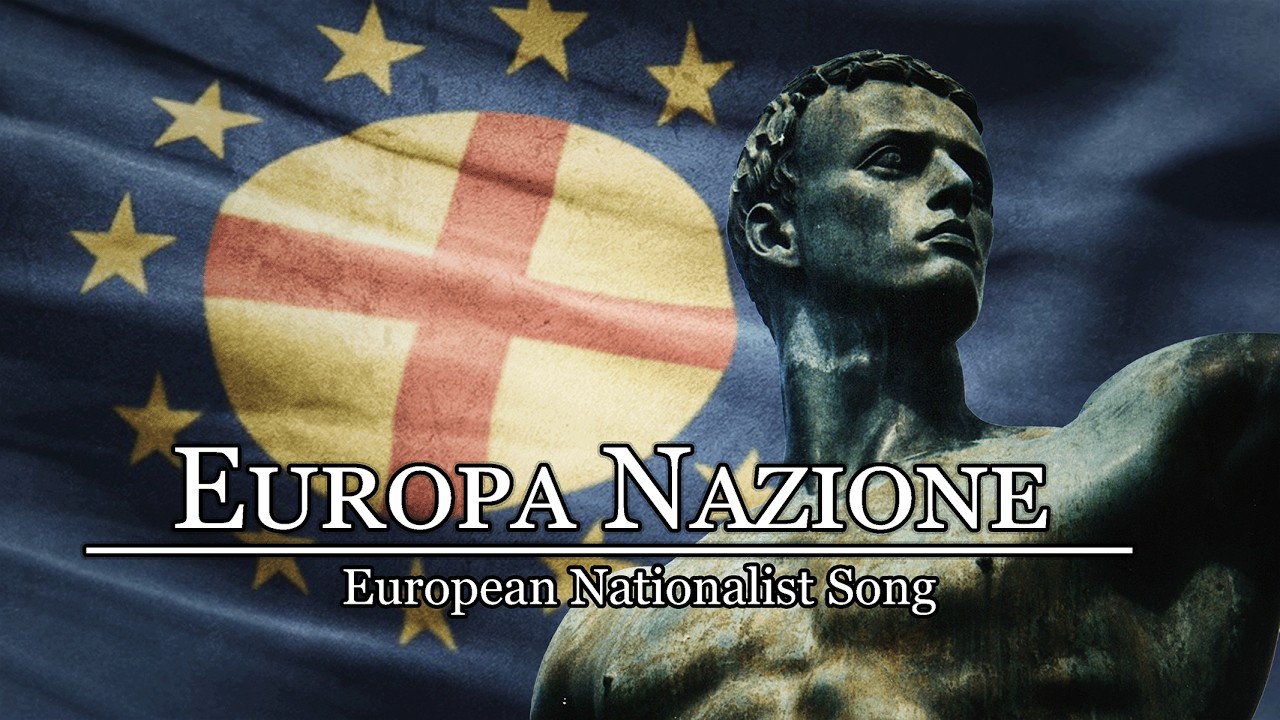
Anthem of the European Federation :smiley:

2 Likes

A very cautious Yes (EU citizen), that is my vote, but I will first start with the potential for a no answer, then move on to more positive aspects.

Why I would lean towards a no: the Germans, the French, heck most of western Europe denigrated my people and called us gypsies for decades, getting my folks through mud (but we are not, they are a separate ethnicity from Romanians and I think that judging a whole group for few or even many bad apples is not really the ideal, but well, all groups have their prejudices and anyone has the right to have negative views of others) and they do not and they will never fully accept us as their peers, although the good news is that they don’t really love each other’s either.

Nowadays the situation has improved though and the old denigration is slowly diminishing, with Romania gaining a neutral to a favorable view from the western European nations, while many Eastern European nations already accept us since we’ve been neighbors for well, centuries, and due to Romanians supporting their countries through tourism nowadays.

Also, on the same idea, I must mention that there is a lack of cohesion generally speaking when it comes to EU nations and there are already some older and newer groups (wether economical or cultural etc.) within the larger Eu framework.

Second no: non-EU immigration!!

Unrestricted, Mass immigration from non-Christian or from non-secular countries or/and from hostile or incompatible nations and cultures, have brought massess of illiterate or maybe very poorly educated folks And hostile towards democracy, freedom, Christian values, freedom/right of minorities, etc.

We need to stop importing Muslim fundamentalists and people with any criminal records, from any countries, be they from the African continent, refugees from the near and Middle East, etc.

People from south east Asia are IDEAL non-eu immigrants: they do not want to impose their own laws, they do not reject Eu values (minus the whole lgbtq and leftist propaganda which can make anyone sick and that is one extreme which I absolutely dislike as well; gay and other non-majority people should have their rights respected but not pushing or obliging the majority to agree with their political or social or Sexual views and inclinations, etc.), they are TRULY peaceful people unlike some Muslim maniacs who would blow people up or behead “the infidels”.

Let me be clear: non violent and with a clean background Muslim immigrants I consider ok, but Christians and people with/from a Christian background and non religious and Hindu, Buddhists etc. folks I consider more desirable, since they at least do not want to impose their own laws and lifestyle (like some Muslims are calling for sharia law across western nations).

OK, now the good parts lol…

Due to the recent Russian war against Ukraine and due to other wars and recent crises too, the prices of oil and other prices have skyrocketed.
Amidst such tragedies we find some common ground.

Now it becomes a question of survival for our nations, with direct potential threats like Russia near our borders…

The economic issues: China DWARFS any and all EU nations, when viewed as separate entities…
Without a clear EU economical long-term agenda, we’ll all become Chinese puppets or remain American puppets, or some EU nations potentially becoming proxies for Kremlin’s needs.

Only together we stand any chance against rivals (economic ones like China) or partners (since I still view USA as a partner, albeit Idk if for long-term) alike, otherwise they will eat us, zero chance for economical competition or any other competition.

A necessary step if Eu wants to survive.
Clearly not all countries should have the right for veto, otherwise we’ll never reach any consensus or common internal or external vision.

I can’t rely on our Romanian politicians to decide the fate of EU, so less power for them is a good thing.
Some may play Russia’s or other external powers agendas and they would only be a new Hungary if they would have veto power (although so far it has not been the case); anyway, I consider those nations as being in more for economical needs rather than wanting to get involved in politics anyway.

Tier 3 is slightly controversial, but understandable why they get no veto rights or other key decision making Powers…

A good choice.

I Agree with a standing EU military, but I would want eu to build it’s own forces ASAP, in order to deter any possible future threats.
Economy and military are the two pillars of any nation or any group or union, like the EU.

These are brilliant points.

I hate leftist propaganda, which brought both lgbtq madness and the rise of terrorism and other issues in the European nations, so cultural homogenization should not be a thing, since we have different cultural views anyway.

I dislike what the liberal jewish American lobbyists and other third parties and their European partners have brought on America and europe: mass immigration, cultural homogenization through a leftist feminist and extremist(ic) view-point etc.

Also, national cultures are the backbone of Europe, no national cultures, no Europe, but a dictatorial either leftist, rightist or some other mad type of collectivism, and I find none healthy.

We must unite, but we must also preserve our identities, national, cultural, etc.

Great point and the others too.

Regarding capacity, we also have to consider military and economic and demographic factors.

A country like Romania is not a core member, neither is Greece or most Eastern or even most European nations, at least when it comes to capacity and especially ruling the Eu or deciding it’s future…

Indeed.

Other personal views: economically I think it’s time to focus on built/made in Europe, rather than relying on China or other markets, but that’s a long-term goal.
Self sufficiency beats relying on external markets.
Still, that endangers what’s left of a globalist economical model (which seems to be dying), which good or bad at least proved reliable for decades if not more than that.
Still, global economy can continue to work either way, regardless of internal changes, since many things will still be far cheaper to buy from huge industries like China, etc.

Basically o would like to retain close economical ties with anyone, but also have eu shift towards self sufficiency, long-term…

What nations I consider worthy of ruling eu: Germany and France are the two worthy nations, in terms of overall power and when speaking in leader/leading capacity terms: they have the demographics, the economical might and are key players politically.


Some Historical background: while in the first centuries after Christ, Rome ruled Europe (well, some parts of it), it was then Christianity (itself the religion of Rome basically, which later replaced the greco-roman religion and other religions in other non-roman territories) and the Germanic chieftains and later Germanic kings which built the European nations.

Germany was the strongest European power (Holy Roman Empire of the German Nation, as it was called during the latest stages of its existance), alongside the French and a few other key players, particularly the English, the Spanish, the Italians, etc.
If we extend the view towards east too, then Byzantium (medieval (eastern) Roman empire) was the strongest European player, until 1200s or so (although we can say that after manzikert disaster they were becoming weaker and weaker, thus we can place their downfall in the 11th century), but that and other ancient and medieval powers are long gone, thanks to the Turks, Arabs, crusades, countless European wars, etc.

Universities I would consider a clear indication of strong advanced cultures, and the Italians, the English and others excelled there.

I would say that the modern European nations were already a thing during the 11th century or even further back for some (the carolingian partition clearly brought forth Germany and France and that was during the 9th century), with the finishing touch being done by 1400s to 1600s and with modern rebranding or independence achieved since the French revolution forward.

It’s a long story so I won’t get into the details: Germany and France I consider the two pillars (well, Britain used to be among the top 3 European powers) of modern Europe.
Due to their huge power and influence, I think they are the best leaders Europe can get, although nations like Italy used to be among the top players, and maybe they still are, but clearly lagging behind the German behemoth, just like Spain and other ex-powers.

While Poland is rising, they do not have the potential to reach European leadership levels, since they do not have the economic capacity of countries like Germany, for example.

While ideally we should all get a voice, idealism is dying, while pragmatism and real-politik(s) win(s), long-term.

Still, Eastern European nations have also brought huge contribution to the European project, through our markets, partnership and HUGE workforce.

The Germans and the western powers got lazy, not many would want to work low paid jobs, so they relied on cheap Romanian and Bulgarian workforce, previously polish cheap workforce, etc.

Eastern European brought a huge eastern market and a pool of potential workers for the rich western nations.

Nowadays, we are starting to do better and I don’t think that that many Romanians are even willing to immigrate to Germany, Italy, Spain, UK, France or Scandinavian nations, among the top destinations.
Of course, mass immigration from non Eu countries and a changing demographic and cultural landscape in the west are massive reasons to not even bother anymore…


Anyway, to conclude my post: modern Europe has been born after two horrible European/world wars, so at least I hope we can all agree that European wars should Never be a thing anymore, hopefully not even for the most distant future.

New threats, both external and internal call for a unity among Europeans and hopefully a brighter future, together.

As for the Americans or Russians or Chinese or anyone else, I do not consider them our enemies, but I Also do not want to become or remain their vassals, rather I would want to see a stronger European Union rising, which will DETER anyone from seeing us as weak prey, but rather to consider us, once again, a World Power…
And a Powerful Partner.

Weak partners become vassals; in partnership, there are only either strong powers working together and respecting each other’s or strong players and their vassals…
Unfortunately respecting weaker nations or blocs is still far from reality, thus we NEED to adapt.
Still, diplomacy, besides becoming a key economic player internationally/on the world stage, is an old tool that Europeans mastered centuries ago, and we can employ it again.

1 Like

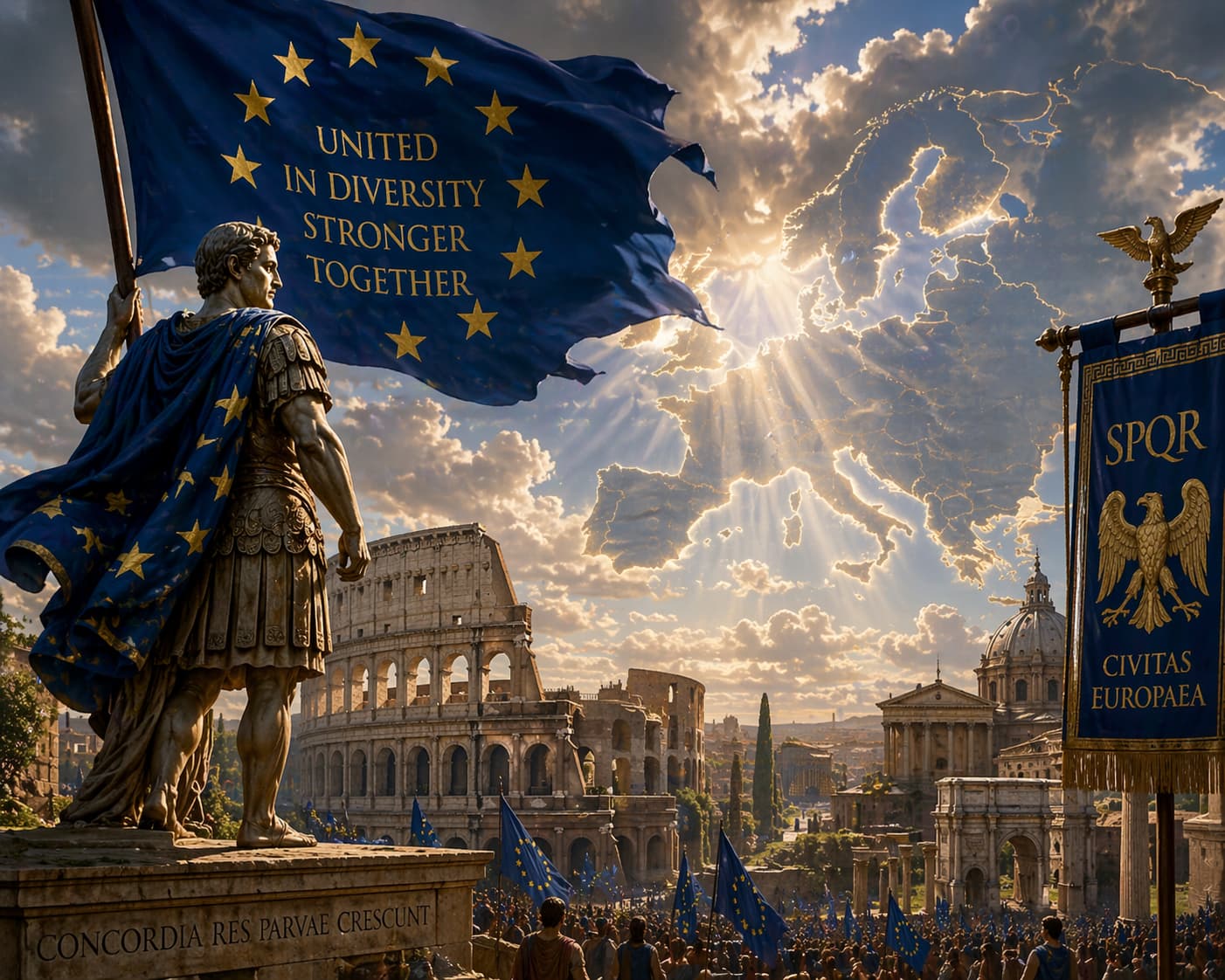
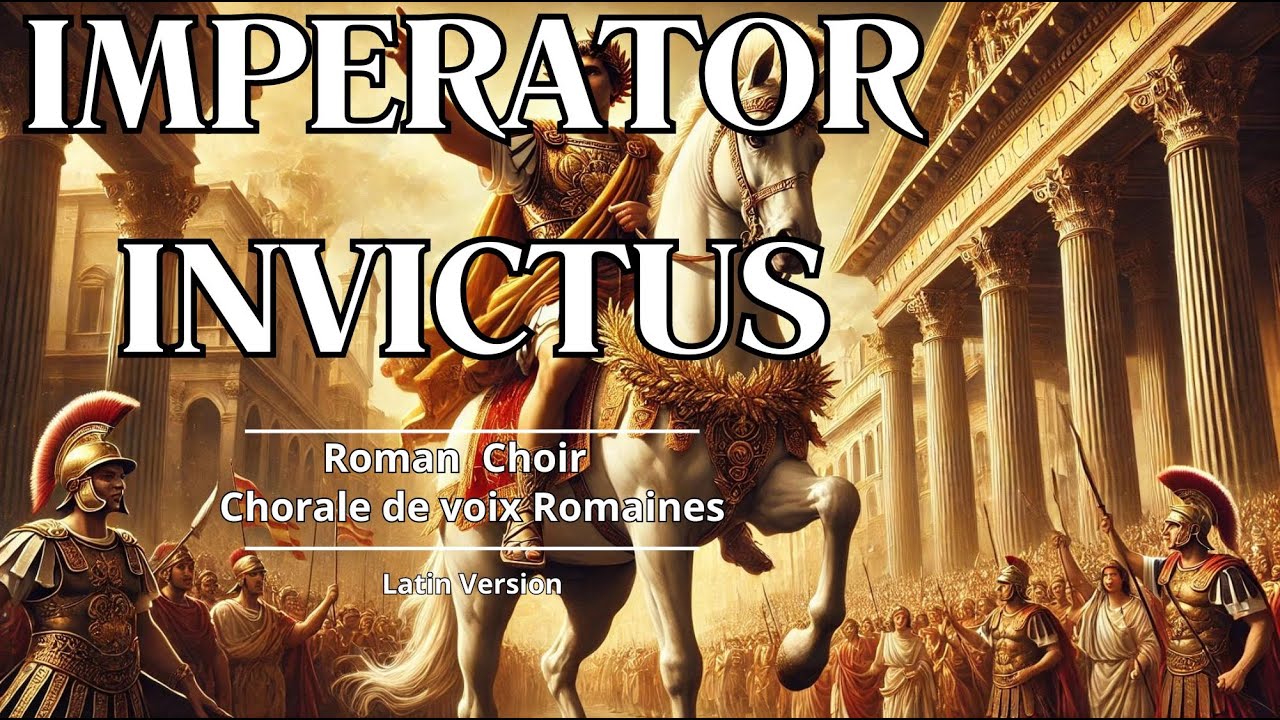
That image is fabulous!

Also, while I love Rome and it’s Legacy, we also have to consider the countless European powers which rose and fell since ancient times.

I would say we are no longer in Rome 's shadow, unlike the dark Early Medieval Ages, when the Christian - Feudal structure got implemented across Europe, nor during the Renaissance, when Roman values and arts and writings and leftovers were being rediscovered and people were amazed by their glorious empire and civilization.

The British, the French, the Germans and pretty much any powerful European power, which had an empire of their own, surpassed Rome, in many ways, and overall, modern world and industrialization and post-industrial, high tech world is clearly levels above roman world, but, we still need to look to our past to know where we come from, and I would say that Rome and Greece are the oldest foundation of the Western Civilization, and we must NOT forget the, rather we should try to learn from them and surpass their achievements and good points/parts, etc.

Anyway, Glorious Image!

1 Like

I’m glad aobut recent happenings seeing how they’ve gone against the worst predictions. But…it’s still going on.

1 Like

Interesting stuff. Thanks for the link. I’ve seen like a couple Facebook reels of his, but did not bother to thoroughly search for his theories or predictions, yet.

For some reason, Samuel P. Huntington’s “The Clash of Civilizations” comes to (my) mind…

I also wonder if there are different timelines with vastly different outcomes, especially with the same root event/events and background as ours?

Maybe in some timelines, Pax Judaica wins, maybe in some timelines Islam (a branch or multiple) wins and maybe in some timelines Russia wins or maybe China or in a ferocious mutual destruction, the winners are the second powers or those uninvolved (those “the meek shall inherit the earth”, to give a Bible quote), ushering in an Era of Peace and mutual collaboration.

I think that the collective consciousness wins, whoever has more sway, uses the collective energy and spiritual power to materialize theirs/their faction(s) victory…

And there’s the negative ETs business, like maybe it is not about winning or losing or whoever sits on the “Throne of Ashes”, but rather about some unknown or slightly known beings or type of consciousness playing humanity against itself, while they fine dine on the human souls ’ collective agony…

The puppet master pulling their strings, just maybe, yet also, again, we are Also Divine, and that’s why I don’t believe in any scriptures or apocalypse SCENARIOS, because all of them can change or rather they can be changed, if the people change…

Anyway, at the end of they day, someone’s gonna win and I hope it’s all of us lol…

Or at least I still hope for THE Best outcome, for ALL parties, jews and goyim, Muslims and infidels, westerners and everyone else, etc., no matter how you frame the parties involved.

1 Like

I agree for the most part, it’s sure a long shot. Lots of things to resolve and align.

But I think there should be an effort to reduce vetoes and have common foreign policy.

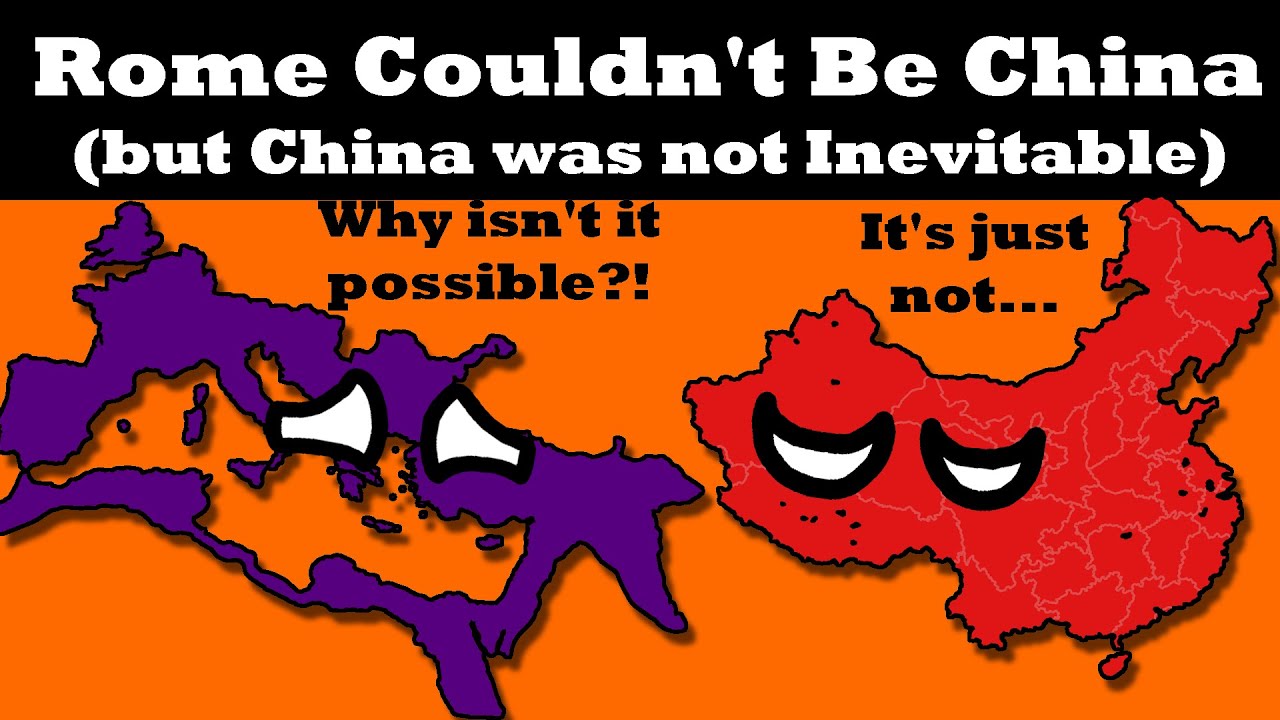
Other empires, states, groups, etc. contributed a lot as well, it’s been a long time, but I don’t think you can anyhow compare it like that. They didn’t, like, start from scratch (plus lots of another context as well). Roman Empire lasted for like 2000 years, and pretty much laid out a lot of the foundation.

Did you know that the division of Belgium (into Flanders and Wallonia) is pretty much traced to where Romans put their roads? :smiley:

I voted very cautious yes. The flood of third world muslims must be stopped. There are already countries where they can enjoy and impose their… “peace”. I see what happens to UK, Sweden, Germany, many other countries I like and I hate it. soon all immigrants will pay for what specific group does.

If this hapes then very cautious yes.

(oh and no, I’m not doing the whole “not ALL members of group x” and “I’m not racist, but…” thing anymore. I see the results and talk is cheap. I look at actions now.)

1 Like

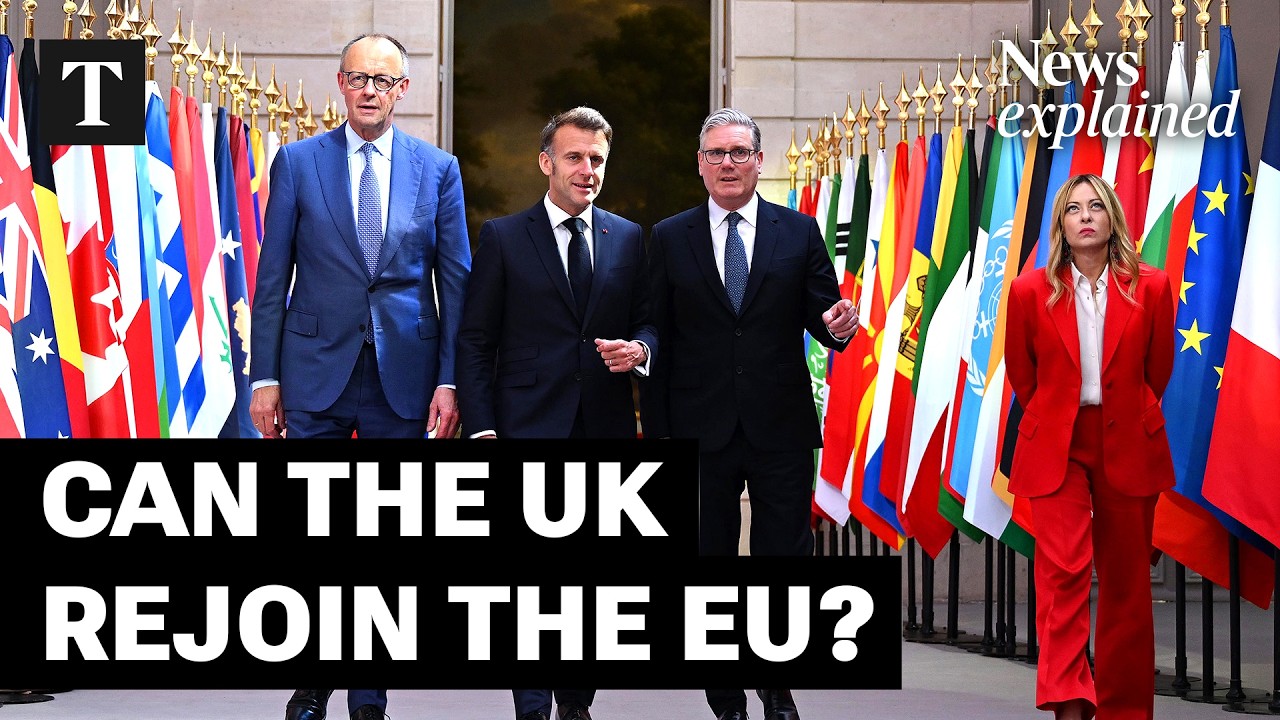
Ig, time to re-welcome them :smiley:

The Parable of the Lost Son (or Prodigal Son), found in Luke 15:11-32, is a story told by Jesus about a father’s unconditional love and forgiveness. A younger son wastes his inheritance in a distant land, hits rock bottom, and returns home. The father joyfully embraces him, celebrating his return, while the faithful older brother struggles with jealousy.

No special status this time tho