Koans Library

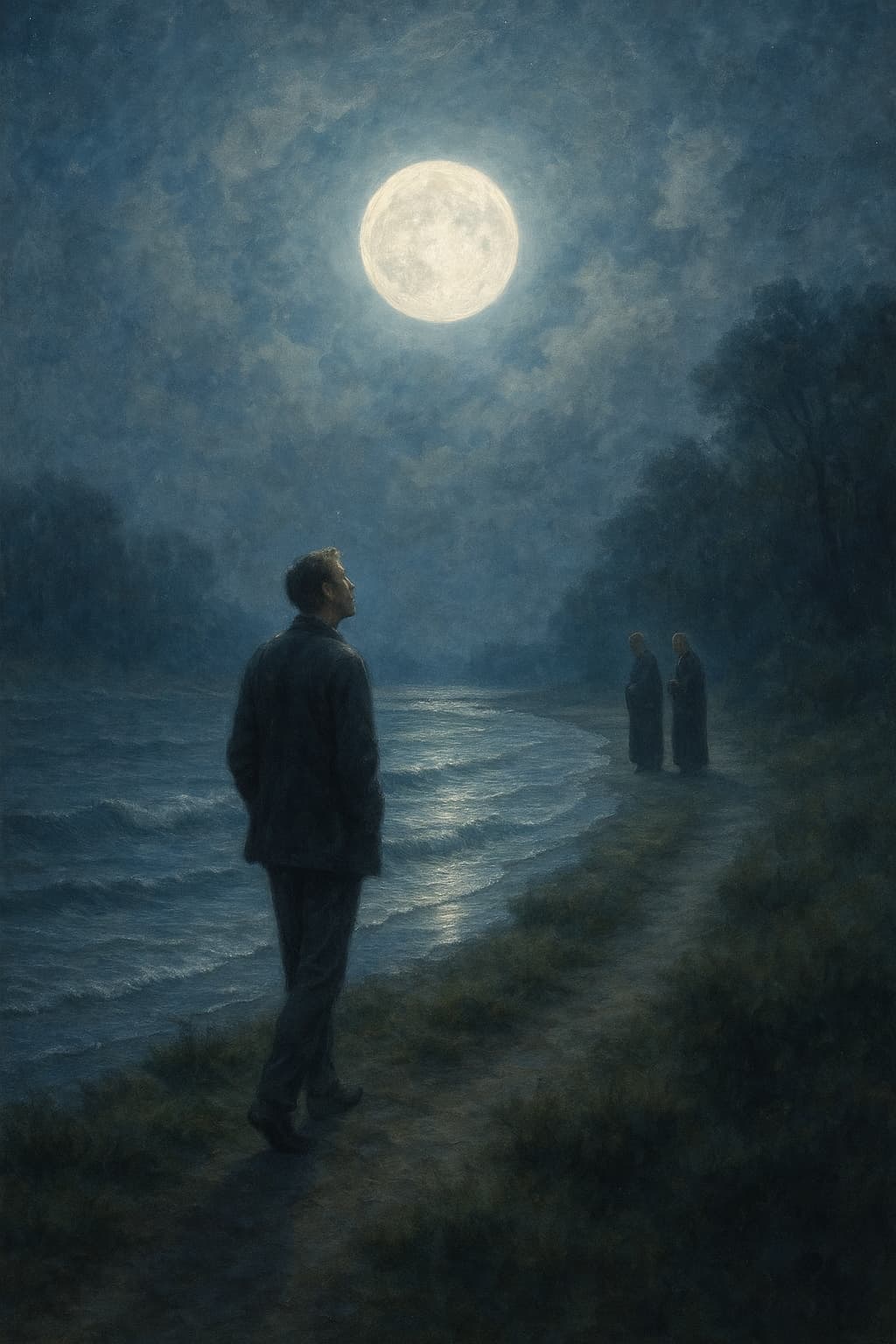
The Silent Moon Moves the Sea

A monk asked the master,
“How can stillness cause waves?”

The master said nothing.
He simply walked to the garden and pointed at the moon.

The monk stared at it and cried out,
“But it does nothing!”

The master whispered,
“Exactly.”

That night, the monk stood by the river.
The tide rose to his knees.
The moon said nothing.
Still, he bowed.

7 Likes

Lol, I don’t get it.
What is the moral of the story?
That “silent forces exist”?
That “human ears cannot hear gravity’s effect on water”?
That “master speaks in riddles and therefore he is supposed to be wise”?

The power of stilling the mind and it’s effects (whether inward or outward)

A metaphorical comparison to how The Moon doesn’t make any noise but still stirs the oceans

The Moon’s gravity pulls on The Earth, and because water is more mobile than land, it causes the oceans to bulge out in the direction of The Moon and on the opposite side.

Also can be seen as

One doesn’t have to speak loudly to get attention or cause change

Sometimes doing/saying nothing is the best option

2 Likes

So the monk bowed to a cause and effect that would have happened either way?
I.e. the monk worshipping the moon’s gravity effect?

And then on the other hand, if the moon “did nothing” in the perception of the monk, then why is he still bowing to it?

Means that the monk got himself into cognitive dissonance, believing one thing while doing the other, lmao, all just to please the master and be a good boy…

…because the master is “always right”, isn’t he?

So the moral of the story is:

Master who speaks in riddles causes cognitive dissonance in monk pupil who wants to be a good boy and finds wisdom in everything the master does, becoming a victim of the master’s halo effect.

Besides, its not really “nothing”.

We feel the earth is still yet its moving at sth like 30km/s. We are doing our daily lives at astronomical speeds. The moon is sth like 30 times faster.

Not really “nothing”.

Not the best analogy, the master needs a master :smiley:

But of course I understand the point that the mind can create innumerable ripple effects.

1 Like

I’ll respond some time during my down time while at work tonight …

But he is bowing to it.

Its not about the monk or master

Its about the moon.

(At least from one of more perspectives you can look at it)

3 Likes

I see now.
This make sense.
The moon just is.
And it is silent.
It says nothing.
And it moves the sea.
Hence the title “The Silent Moon Moves the Sea”.
Makes sense to me, the deep wisdom is hidden in the title.
It was never about master and monk.
Because the moon moves the sea while the monk stands by the river with the tide at his knees.
Two separate stories.
Story #1 - Silent moon moving the sea.
Story #2 - Monk at river bowing down after having some irrational thoughts implanted from his master.

:smiley:

1 Like

Monk could bow to recognition of this.

Maybe it made to sense to monk too :grin:

The Man Who Didn’t Bow

A man said,
“The monk bowed because his master planted thoughts in his head.”

He smiled faintly.
“But the moon just is. It says nothing. It moves the sea.
I see that now. No need for theatrics.”

He walked the riverbank in silence,
hands in his pockets,
watching the tide roll in.

A breeze passed.
He looked up at the moon for a moment too long.

Then he kept walking.

The monk turned to the master and said,
“He didn’t bow.”

The master replied,
“No. But the moon received it anyway.”

6 Likes

Beautiful

2 Likes

Yep I agree

And the act of bowing is also a sign of gratitude amongst other things

For gratitude for the lesson

Also, there may not have been a “cause and effect that happens either ways”

Because, maybe The Moon showed its power within it’s stillness to the monk by rising the tides particularly where the monk is
Not in a scientific manner but a divine manner
Only to show the monk what it means to have power in stillness?

Just another possible happening within what’s possibly explained in the story

5 Likes

The Waiting Tea

A student said to the master,

“I saw the clear water, but did not drink.
I passed the flame, but did not warm my hands.”

The master poured tea for two,
though only one cup was lifted.
He said,

“When you are truly thirsty,
even silence will offer a cup.”

3 Likes

Koan of the Fire Not Used

A young monk came to the master with eyes weary and heart restless.

“Master,” he said, “I feel emotions like wild beasts—fear, desire, shame, longing.
They rise without warning and leave me tired.
I meditate, I walk, I breathe.
But nothing changes.
Am I cursed?”

The master poured tea, but did not hand him the cup.

“You are not cursed,” he said.
“You are burning.
But you do not know how to burn.”

The monk looked confused.

“Burn? Master, I want peace, not more fire.”

The master nodded and pointed to the brazier.

“If you place wood in the fire and do not cook food…
you will only have smoke.
That smoke will sting your eyes, choke your breath, and fill the room with bitterness.
But if you place the pot with intention, the same flame makes nourishment.”

The monk looked down.

“So what I feel… is Tapasya?”

The master smiled.

“Yes. Tapasya unrecognised is just heat.
It scalds.
It confuses.
It tires you out.”

“But Tapasya realised…”
—he gently handed the monk the cup of tea—
“becomes purification.
It cooks your illusions into wisdom.
It distills your pain into presence.”

The monk held the cup and whispered,

“Then why does it hurt so much to sit in it?”

The master placed his hand on the monk’s heart.

“Because you have not bowed to the flame yet.
You resist, but the fire does not.
Let yourself burn—softly, slowly, with breath.
Cry, if you must.
But do not flee.
The discomfort is not your enemy.
It is your teacher.”

The monk bowed deeply.

That night, he did not meditate.
He sat quietly with his fear.
He watched it rise.
He did not move.

The fire flickered in the temple.
And for the first time,
it warmed him.

3 Likes

The Koan of the Heavy Air

A young monk came to Master Karuna and said,
“Master, I walk through the marketplace and feel my breath grow shallow.
The faces are hurried, the air is thick,
and I forget who I am by the time I return to my room.”

The Master sipped his tea and said,
“Then stop carrying the world in your sleeves.”

“But Master,” the monk replied,
“How do I walk through the noise without becoming noise?
How do I look into tired eyes and not become tired?”

The Master pointed to a candle in the corner.
“It does not run from the wind,
nor does it argue with the darkness.
It simply burns from within its own wick.”

“Must I then hide from the world?” asked the monk.

The Master laughed.
“Hide? No. But learn to bow without kneeling.
See the storm, but do not drink its rain.”

That night, the monk returned to the marketplace.
He walked slower.
He breathed deeper.
He smiled at no one, but everyone felt seen.

In time, the market forgot his face—
but remembered his silence.

3 Likes

I think the lesson here is to drink more tea

3 Likes