Wow!
I was thinking, i felt that! it was automated with the Crystal of Insight but when i read the “split” part…
Thats exactly how i felt today when looping for a second set of loops that field. You of course explain it much better! Thank you 
Wow!
I was thinking, i felt that! it was automated with the Crystal of Insight but when i read the “split” part…
Thats exactly how i felt today when looping for a second set of loops that field. You of course explain it much better! Thank you
Exposés and Concepts
The past few days I was thinking about some posts and how to really address them as some of the realizations on the path, I had were quite hard to put into words. So I will title this “train of thoughts” as the following:
Intellectual Understanding vs. Experiential Realization
I wanted to share a profound excerpt I came across, although this pertains to the discussion on eight-fold path, it shares similarities with Ngondro (Path of Infinite Echoes) and how both spiritual paths address the importance of Ethical Conduct, Mental Discipline, and Attaining Wisdom.
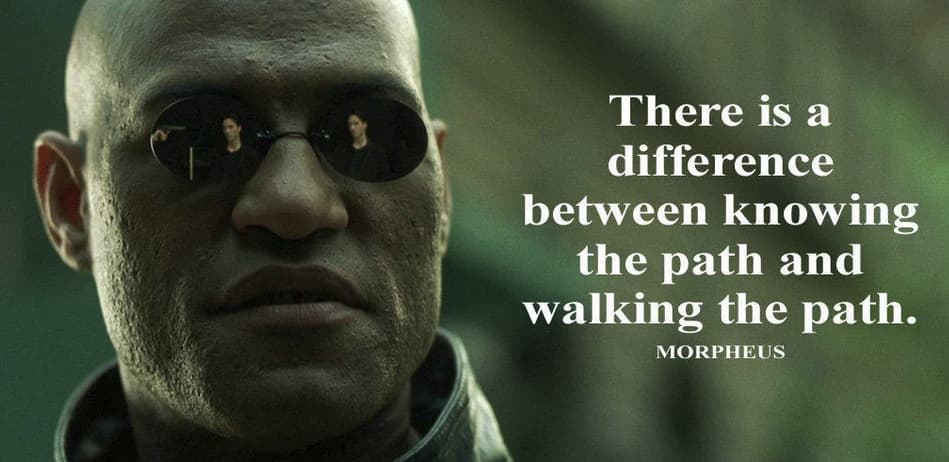
Moreover, Why look deeper into this? You know, just read the words and figure it out, right?
But it’s more to it than that, and this sheds light on its nuances
Bhikkhu Bodhi on Right View and Insight
Bhikkhu Bodhi emphasizes the distinction between intellectual understanding and experiential realization in his explanation of the Noble Eightfold Path. He notes that acquiring the right view involves first learning and studying the truths, which leads to a conceptual understanding. However, this understanding remains incomplete until it is deepened through reflection and meditation, ultimately leading to direct experiential insight:
“To acquire the right view that accords with the truths requires a clear understanding of their meaning and significance in our lives. Such an understanding arises first by learning the truths and studying them. Subsequently, it is deepened by reflecting upon them in the light of experience until one gains a strong conviction as to their veracity. But even at this point, the truths have not been penetrated, and thus the understanding achieved is still defective, a matter of concept rather than perception”
Example:
Reading about NDEs, OBEs, the “Afterlife”
Practical Astral Projection for personal experience of being immortal
I’ve had the thought before while I was in school. I decided to go straight toward experiential understanding - for the things that matter. If my mind follows, then it follows.
Purification is crucial in magical practices to ensure the effectiveness and safety of outcomes. The goal is to remove negative influences, focus intentions, and protect oneself. Magicians have a variety of methods they use, while these methods can solve specific issues, they are akin to strategies with inherent flaws.
Those of you who have studied traditional magic may know magicians make use of external tools or rituals for purification. While these methods can be effective in the short term, they come with several limitations. One significant limitation is that these techniques, primarily address the immediate environment and may not penetrate deeper layers of the practitioner’s being. This superficial cleansing means that the deeper, more ingrained impurities remain untouched.
Another limitation is the temporary nature of the effects. The benefits of these practices are often short-lived, necessitating repeated rituals to maintain a purified state. This constant need for repetition can be both time-consuming and unsustainable in the long run. Additionally, many well known practices lack a strong ethical foundation. Without an emphasis on ethical and moral principles, practitioners can become vulnerable to negative influences.
Improper use of magical practices can result in unintended consequences. These adverse effects can undermine the practitioner’s well-being and overall spiritual progress. The on-going pattern to recognize here is only a single-aspect is being addressed rather than a whole system with a history of practice and refinement.
Western occult traditions are often fragmented and internally divided. Different schools of thought, have their own unique practices and philosophies, which can sometimes be at odds with one another. This lack of cohesion can make it difficult for practitioners to find a unified path and can lead to conflicts within the community.
This is where a Holistic Alternative: The System of Patanjali Purity Alchemy can be adopted as it can fortify the effectiveness of one’s magical practice with greater depth. This Yoga serves the body, mind, and spirit along with physical and mental purification. Which also provides ethical and spiritual enrichment for an individual. The emphasis is on ‘internal’ transformative practices, poised for sustainable growth whereby practitioners are less susceptible to the pitfalls of a myopic practice.
I wanted to share some insights on a fundamental teaching called—the Eight Worldly Dharmas illustrated as “Winds”. These are essentially the external conditions that can ‘sway’ our emotions and actions, often leading us away from inner peace and spiritual growth. Also about the development of a "baseline"and equanimity.
Are ‘pairs of opposites’ that describe the transient nature of our experiences: “that represent the fluctuating conditions of life”
Being aware of these conditions is essential because they are impermanent. When we cling to gain, fame, praise, and pleasure, we set ourselves up for inevitable disappointment when their opposites arise. This cycle keeps us bound to samsara, the cycle of suffering. By recognizing the transient nature of these conditions, we can ‘cultivate equanimity’ and stability in the mind and reduce our emotional turmoil.
To maintain equanimity amidst the Eight Worldly Winds, one can practice the following techniques:
So the winds are a natural part of our life, but they don’t have to control us. Combined with the awareness of all the five hinderances (States that cloud the mind + hinder progress), we can reduce our emotional reactivity and attachment to worldly conditions brings us closer to the ultimate goal of liberation.
Moreover, by incorporating these practices or fields we can navigate these conditions “skillfully” and continue to develop a stable mental state or ‘base’ that remains unaffected by the external conditions or winds. This balanced state is akin to mental homeostasis, where the mind remains calm and composed regardless of the highs and lows of life.
Impermanence (Development of observation)
Samsara (Higher Awareness)
Karma (Reactionary nature and maintenance of conduct)
Purity Alchemy (Strongest Base, Stability, Deep Purification, Overcome all afflictions, deep awareness, inner focus)
There are many benefits, check all descriptions via link
We are limited by language here.. but all these fields work synergistically to develop, solidify that strong base, quick and efficiently.
The focus is about cultivating / building and experiencing those states, and then creating a Feedback loop.
Cultivate Mind Awareness (Using the method of compartmentalization observe mind, mindfulness)
|
V
Begin observing/analyzing your thoughts and feelings + knowledge eight worldly winds
|
V
Cultivate a stable, peaceful state of mind (practice + meditation or field’s exposure)
Over time this will solidify and create a base level, where you can turn back to
|
V
Gain Awareness of fluctuation (ups and downs), recognize eight worldly winds
|
V
Observe Ebbs and Flows + recognize impermanence
|
V
Maintain Mental Homeostasis by going to the beginning of the loop, which starts with awareness of mind, knowledge, the equanimous stable mind, what ‘mental affliction’ is causing the fluctuation etc.
|
V
Use Equanimous ‘state’ that has been cultivated/developed as a ‘Stable Base’ or ‘Reference Point’ + Don’t React, wait for it to subside. (Just like the analogy of the wind, can be like how the weather changes etc.)
If you let it control, and you do react, then you just lost awareness etc. Then realize that, use purity alchemy, use the recommended field sets, or the three practices, and start from the beginning again.
My advice: Make this set of fields a routine, which becomes second nature, habitual. Just like brushing your teeth, taking a shower, if and when things turn south, go into a cleaning mode, deal with it asap. Bouncing back to the equilibrium. This is the real mind training.
Understanding and overcoming these conditions is crucial for anyone on the path to enlightenment.
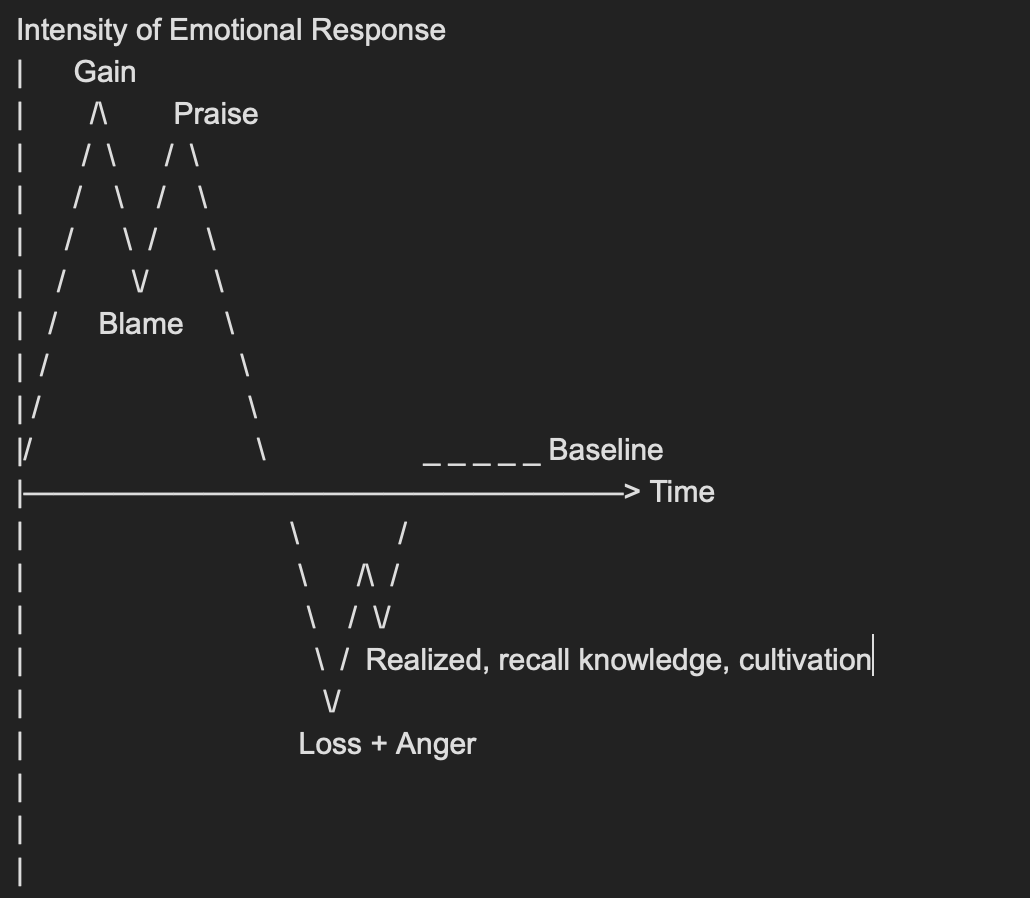
Lastly here, here is visual drawing, so you get the idea.
To visualize the mental state of an individual experiencing the ups and downs of the Eight Worldly Winds, we can use a graph to represent the fluctuations. The x-axis represents time, and the y-axis represents the intensity of emotional responses
This exercise is designed to help you cultivate morality (sila) and good karma by focusing on various aspects of character development. By engaging in this exercise, you’ll work on improving kindness, communication, generosity, patience, and other moral qualities.
*For those of you who have a Daily Journal in the Forum, you may consider using this:
Start by creating a personal character sheet. This will serve as a tool to track your progress in various moral aspects. Here are some categories to include:
To effectively track your progress in developing morality, it’s important to incorporate daily practices that allow for reflection and self-assessment. Here’s how you can do it:
Begin with Daily Journaling:
For each category, set specific, measurable goals. For example, under “Kindness toward yourself,” you might set a goal to practice self-compassion daily. Under “Generosity,” you might aim to perform one act of kindness each week.
Track your progress regularly. You can use a journal, spreadsheet, or any other method that works for you. Reflect on your achievements and areas for improvement.
Incorporate daily reflection and mindfulness practices to stay aware of your thoughts, words, and actions. This will help you align your behavior with your moral goals.
Actively seek opportunities to practice positive actions being upright, gentle, humble, contented, and controlled in senses.
Ensure that you balance your efforts to help others with self-care. Avoid burnout by pacing yourself and taking time to recharge.
Be mindful of common pitfalls such as guilt and self-oppression. If you make a mistake, practice wise remorse by acknowledging it and resolving to do better next time.
Morality is an ongoing practice. Continuously seek to improve by learning from your experiences and adjusting your goals as needed.
Here’s a simple chart you can follow and fill in daily:
Like a business manager, tracking Key Performance Indicators (KPIs) is similar to monitoring these self improvement statistics. Initially, it may seem unnecessary, but KPIs are invaluable tools with practical applications in real-world scenarios as are these. They are especially beneficial for improving consistency and achieving desired results.
Consider the example of a person who is a beginner in weight-lifting or exercising. When starting out, they adhere to a structured gym routine like (5x5), learning fundamental compound exercises and documenting their progress daily and weekly. This method helps build a solid foundation. Similarly, when I first began working out, I meticulously recorded my split days for different muscle groups such as chest, back, and legs. (Including thoughts, feelings, diet)
Remember, developing morality is a continuous journey that requires patience, balance, and a positive attitude. Enjoy the process and celebrate your progress along the way.
There is a “t” where it shouldn’t, since the subject is “Morality”
Thanks


Fixed, thanks it was autocorrect.
Morality and ethics, simple steps towards a better world 


Thanks for your initial post. 


A post was merged into an existing topic: General Talk
how about a bardo field which guides on trough all stages and allows one to process and integrate it?