I suppose height growth 2.0 is based on a part of this concept. Here it’s explained in details. So keeping this in mind I suppose the more (resting) steme cells one has in bones will have the higher chance of bone growth? So what if the amount of steme cells and necessary elements are increased on these specific locations? @Dreamweaver if interested kindly have a look and see if it’s possible to make something out of it combining with the older one with some time reversal methods like pre-existing state of bones before growth plates fusion etc (if that’s possible)
1 Like
Telekinesis

I be so lazy if this is going to happen
5 Likes
I know a free field that will get you there.
Really?
Spill the deets lol
If you do already pranayama / star exercise it’s not gonna be faster…
If you want superpowers you have to train harder 
(it’s mstate gold btw, a lot of things can be spammed without too much consequence but not that one)
3 Likes
I like to request a Didgeridoo field. The Didgeridoo is a intrument of Aboriginal peoples of northern Australia, who use it at least 1,500 years ago to today. It´s say you could enter in a expanded state of mind by listening to it by less than 3 minutes.
Alfredo
1 Like
The Dreamtime and Plasma Flower Node Point Connector make use of it and give many of the benefits associated with that instrument. But who knows, maybe there will be a specific field someday :)
3 Likes
For the PCOS ladies, you guys could maybe create a “spironolactone + progesterone” audio, that’ll be nice.
or, like Atreides said, one to regulate/reduce GnRH.
1 Like
Please make one free downloadable audio for all combining 5 audios
- subconscious limit dissolver
- become whole
- extreme self esteem & confidence
- inner piller of power &
- unstoppable will
These are the basic audio everyone should listen everyday. It would be great if it is available in one single audio. It will save a lot of time for busy people too. Thank you.
5 Likes
Request to please update the remove all addictions morphic field.
Found this article https://www.biologicalpsychiatryjournal.com/article/S0006-3223(20)30131-1/fulltext#%20
which led to this: Frontiers | Muscarinic M4 Receptors on Cholinergic and Dopamine D1 Receptor-Expressing Neurons Have Opposing Functionality for Positive Reinforcement and Influence Impulsivity
quoting a part-
“The neurotransmitter acetylcholine has been implicated in reward learning and drug addiction. However, the roles of the various cholinergic receptor subtypes on different neuron populations remain elusive… Our study illustrates that muscarinic M4Rs on specific neural populations, either cholinergic or D1R-expressing, are pivotal for learning processes related to both natural reward and drugs of abuse, with opposing functionality.”
My primary motivation for asking is- I have been spamming the dopamine receptor repair audio and while it helps a lot, I dont think I’m making a lot of improvement i.e. unable to reset my dopamine level baseline back to how it was 4 years ago before I started drinking, smoking etc. I’ve quit all that but I still can’t get excited about general life as much as I would in those past days, and that is my primary aim- to reset my dopamine baseline to such a high level that difficult things start giving me pleasure to engage in.
I’ll try to update this answer as I make time to find more papers.
Thanks.
1 Like
Just an idea… maybe a Extreme Self Confidence 2.0? That would be a very underrated new release haha
New Perspectives? And Brain Regeneration. + Brain Refresher and Positive Power Waves from the Lesser Diamonds album. And maybe Mental Health album too. Become Whole aswell. Visual Introspection is a paid one but will help.
2 Likes
A legendary facial remodeling field.
the make up of facial beauty is usually found in its three main components: bones, tissues, and muscles.
This aims to focus on the basal part of the facial bones through the natural process of bone remodeling and resurfacing. and, similar to skin scarring repair, an induced apoptosis to scar tissue on the skin, while also inducing pluripotency to the remaining cells,
This is not meant to address aging in the numerical sense, but rather a negentropical restoration of the natural process that happens in the body.
as well as a ‘remodeling’ effect.
with an exotic Sapien ® ™ blend 
Bone remodeling, continuing process of synthesis and destruction that gives bone its mature structure and maintains normal calcium levels in the body.
Bones are not inert structures within the human body; they continue to change over the course of a lifespan. This process of skeletal change is known as bone remodeling, which both protects the structural integrity of the skeletal system and metabolically contributes to the body’s balance of calcium and phosphorus. Remodeling entails the resorption of old or damaged bone, followed by the deposition of new bone material. The German anatomist and surgeon Julius Wolff developed a law that describes the nature of bone remodeling regarding stresses. Wolff’s Law states that bones will adapt to the degree of mechanical loading, such that an increase in loading will cause the architecture of the internal, spongy bone to strengthen, followed by the strengthening of the cortical layer. Furthermore, a decrease in stress on the bone will cause these bone layers to weaken. The duration, magnitude, and rate of forces applied to the bone (in other words, tendons pulling at their attachments), dictate the way in which the integrity of the bone is altered.
one remodeling is essential for adult bone homeostasis. It comprises two phases: bone formation and resorption. The balance between the two phases is crucial for sustaining bone mass and systemic mineral homeostasis. This review highlights recent work on physiological bone remodeling and discusses our knowledge of how systemic and growth factors regulate this process.
Bone Remodeling and the Skeleton: Why the face?
The facial skeleton has a profound effect on an individual’s appearance. A defining characteristic of youth is good skeletal structural support. Facial aging results from a combination of soft tissue and bony changes, with bone loss in specific areas of the facial skeleton contributing significantly to the features of the aging face. This comprehensive review highlights the specific areas known to resorb with aging. It is conceptually important to appreciate that in most individuals with premature aging, the facial skeleton can be inherently inadequate. Accordingly, the changes in the facial skeleton that result from the aging process must be addressed to obtain a natural-appearing facial rejuvenation.
The skeleton is an extremely specialized and dynamic organ that undergoes continuous regeneration. The process of bone modeling is responsible for the formation and maintenance of the shape of bone. Bone modeling leads to the acquisition of peak bone mass. It begins in fetal life and continues until skeletal maturity (i.e., epiphyseal plate closure or completion of longitudinal growth of the skeleton). Bone modeling occurs by removal of bone from one site and formation of bone at different sites. The bone regeneration process persists even after skeletal maturity by periodic replacement of old bone with newly formed bone at the same location, called remodeling. Bone remodeling is required for repair of old damaged bone due to daily physical load and prevention of aging effects and its consequences. Impairment in the bone remodeling process often results in the progression to osteoporosis, a major worldwide health concern. The overall process of bone remodeling is a tightly controlled and coordinated process regulated by a number of cell types. The maintenance of physiological bone remodeling and systemic mineral homeostasis requires balance between bone formation and bone resorption
The traditional concepts of facial aging revolve around the theme of changes occurring in the soft tissues, with atrophic laxity leading to tissue descent. Facial rejuvenation techniques have focused on reversing these changes by repositioning and redraping of the tissues, with an emphasis on vectors of lift. Although these approaches are effective to a major degree, they do not necessarily produce a completely harmonious or natural rejuvenation. The recent addition of volume to the soft tissues using lipid filling has enabled better restoration of youthful volume and shape than mere lifting alone. Only during the current decade, with the application of three-dimensional CT analyses, has a more accurate understanding of facial skeletal aging been possible. The current review has gathered the isolated pieces of evidence which together unequivocally show that aging of the facial skeleton includes selective resorption at specific sites These changes are mainly in the periorbital and mid cheek and specifically include the superomedial and inferolateral aspects of the orbit, the medial suborbital and pyriform areas of the maxilla, and the prejowl area of the mandible. These sites presumably reach their peak “projection” in early adulthood and gradually lose volume thereafter. Rebuilding these areas of lost skeletal support is another method for restoring projection and facilitating repositioning of the soft tissue. This method also is a fundamental element in achieving the goals of natural-appearing facial rejuvenations.
Bone Remodeling: The Mechanism.
To accomplish normal physiological bone remodeling, the proper coupling of bone formation and bone resorption requires direct communication among different bone cells. Cells of the osteoblast lineage (osteoblasts, osteocytes, and bone-lining cells) and bone-resorbing cells (osteoclasts), together with their precursor cells, are organized in specialized units called bone multicellular units (BMU) (33). Osteoblasts originate from mesenchymal stem cells in the bone marrow stroma and are responsible for bone matrix synthesis and its subsequent mineralization. On the other hand, osteoclasts are large, multinucleated giant cells formed from the fusion of mononuclear progenitors of the monocyte/macrophage in a process termed osteoclastogenesis. The primary purpose of the BMU is to facilitate normal physiological bone remodeling.
There are many factors that can be involved in regulating the precise bone remodeling cycle The remodeling cycle is composed of seven sequential phases, namely, quiescence, activation, resorption, reversal, formation, mineralization, and termination. Activation precedes resorption, which precedes reversal, with termination as the last step.
There are primarily 2 cells that are responsible for both the resorption and deposition phases of bone remodeling: osteoclasts and osteoblasts; however, osteocytes have a role in this process as well. The activity of these cells, particularly the osteoclasts, are influenced directly or indirectly by hormonal signals. This interaction between bone remodeling cells and hormones creates the opportunity for a multitude of pathophysiological consequences.The bone remodeling cycle, which begins in early fetal life, depends on the interaction between 2 cell lineages. Osteoblast cells contribute to bone growth and derive from the mesenchymal origin. Mesenchymal cells are stem cells that can differentiate into a variety of cell types, such as osteoblasts, chondrocytes, myocytes, and adipocytes. Osteoclast cells cause bone resorption and originate from a hematopoietic lineage, which includes various blood cell types from within the bone marrow. The cellular process of the remodeling begins when osteoblast and osteoclast precursor cells fuse to form a multinucleated, osteoclastic cell.
Bones and Youthfulness
The facial skeleton is generally believed to expand continuously throughout life [1–4]. This is reflected in the progressive increase in certain facial anthropometric measurements with age such as the nasion-to-anterior nasal spine and the facial width [5, 6]. The fact that certain areas of the facial skeleton also undergo resorption with aging is not well appreciated or even accepted. For example, it has been thought that maxillary retrusion of the maxilla does not occur with aging in the fully dentate patient [6, 7]. However, contrary to this view, recent evidence clearly demonstrates that aging of the maxilla is primarily one of bone resorptionSelective bone resorption in the facial skeleton is not without precedent. Most notably, in the process of differential growth, areas of bone resorption occur adjacent to areas of bone deposition. Differential growth enables the infant skull to assume the proportions of the adult form [16, 17]. This process continues to remodel the fully dentate mature, facial bone and alters the craniofacial morphology into one that is instantly recognizable as an aged skull.
The question of why certain sites are more prone to bony resorption than others has been the subject of little discussion. The maxilla is the bone that undergoes the most dramatic resorption with aging, the consequences of which are seen in the aging mid cheek. The maxilla differs in origin and function from the other bones that make up the orbital rim, being a bone of dental origin. In youth, the maxilla expands to accommodate the growing secondary dentition, which develops within the bone. Eruption of the secondary dentition results in a major reduction of the maxilla’s volume, especially in its lower part.
Some people inherently “age better” than others. These individuals can be recognized in youth because they have a more attractive face with a strong skeletal structure, as evidenced by the presence of youthful bony features that provide good support to the overlying soft tissues. These features include a prominent supraorbital bar, a strong cheekbone, and a prominent jaw lineBecause these individuals innately have youthful bony contours, they start off “high on the curve” of bony support so that it takes longer for the bone loss of aging to manifest clinically. Conversely, people with poor facial skeletal support never have the ideal contours of youth and start off lower down the curve, and many appear old for their age, even in their 20’s. They are effectively predisposed to manifest aging changes prematurely.Features that portend poor support include a retrusive supraorbital bar, midface hypoplasia, poor zygomatic developmentand microgenia. Regardless of age, once these soft tissue changes are manifest, a significant degree of bony deficiency exists. Correction of the bony element has the potential to deliver a more harmonious facial rejuvenation.Those individuals who started low down the curve should be considered for a skeletal augmentation, not only to reverse the aging changes but also to bring their natural state higher up the curve so that the soft tissues are better supported for a more attractive look. With more youth, these individuals have more in reserve against future aging. Facial bone structures also explain the observation that we tend to age like our parents, a familial trait that we inherit from them.
Areas of focus: where do the facial changes happen?
Periorbital Region
The orbital aperture increases with age, in both area and width. Resorption is, however, uneven and site specific [8]. The superomedial and inferolateral aspects of the orbital rim, in particular, recede more, although the changes occur at different rates (Fig. 1). The inferolateral orbital rim changes manifest earlier, by middle age, whereas in the superomedial quadrant, recession may be noted only in old age. The inferomedial quadrant of the orbit also has a tendency to recede in old age, especially in males [8, 9]. In contrast, the central part of the superior and inferior orbital rims is more stable, with little if any resorption occurring with age
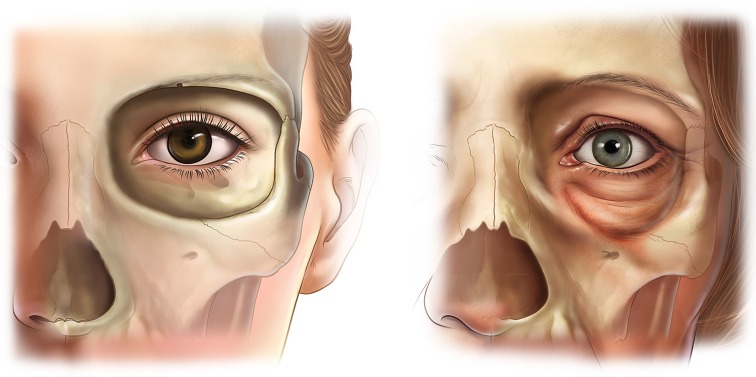
Image explanation: Orbital aging. The superomedial and inferolateral aspects of the orbit have the greatest tendency to resorb. This contributes to the stigmata of periorbital aging such as increased prominence of the medial fat pad, elevation of the medial brow, and lengthening of the lid cheek junction.
Midface
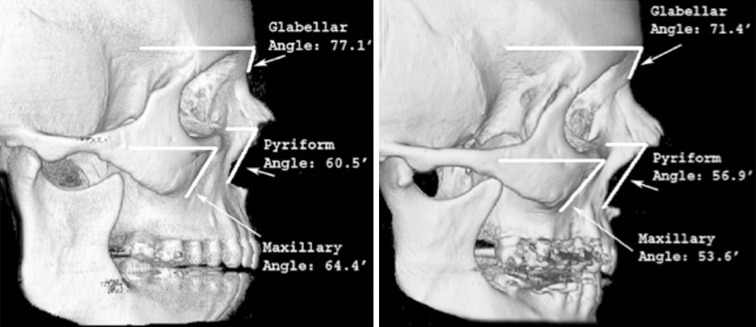
Image explanation: The piriform (piriform angle) and the maxilla (maxillary angle) significantly recede with aging, from youth (left) to old age (right) [11])
The midface skeleton is formed by the maxilla in the medial and middle thirds and by the body and arch of the zygoma in the lateral third. Contrary to conventional orthodontic teaching [4, 5], it has been clearly demonstrated recently that midface retrusion does occur with aging in dentulous patients [10]. The rate of bony resorption in the midface, however, is not uniform. The maxilla is more susceptible to age-related loss than the zygoma [24].
Pessa [10] measured the maxillary angle (superior-to-inferior maxilla at the articulation of the inferior maxillary wing and alveolar arch) of young and old patients and demonstrated significant bone resorption with loss of projection of the maxilla. Shaw and Kahn [11] similarly noted a significant reduction of the maxillary angle with aging (Fig. 2). Using a more precise approach to measurement with standardized parasagittal computed tomography (CT) slices through the midaxis of the orbit to measure the angle between the floor of the orbit and the anterior maxilla, Mendelson et al. [12] confirmed the important finding that the maxilla retrudes with aging and quantitated the changes. The maxillary angle decreased by about 10 ° between young (age < 30 years) and old (age > 60 years) individuals.
Perinasal Changes
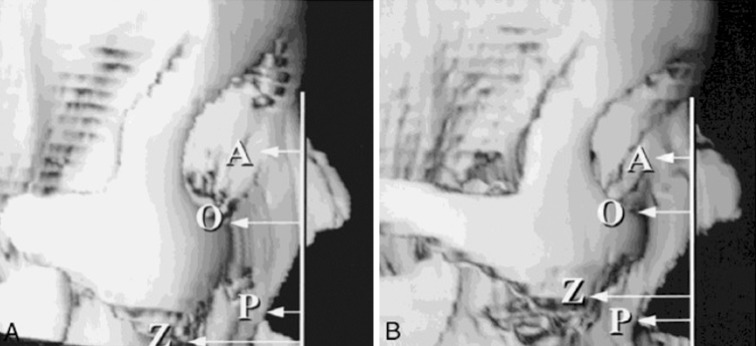
Image explanation: In youth, the piriform (P) lies anterior to the anterior lacrimal crest (A). With aging, the piriform comes to lie posterior to the anterior lacrimal crest as a result of selective bone resorption at the piriform (below) [49]
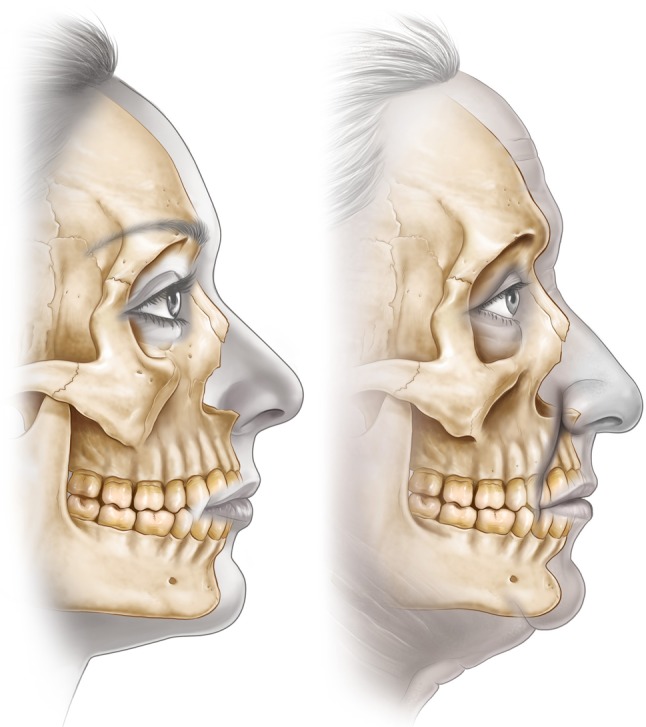
Image explanation: The loss of bone in the pyriform area weakens the support of the lateral crura. Deepening of the maxilla results in posterior positioning of the nasolabial crease and adjacent upper lip
The characteristics of the aging nose are well known and include the following key changes. The nose lengthens and the tip droops, with the collumella and the lateral crurae displacing posteriorly [25]. Changes in the bony foundation that support the nose in youth, the paired nasal bone, and the ascending processes of the maxillae are responsible for many of the soft tissues changes seen in the nose with aging.
Shaw and Khan [11] found that the piriform aperture, resembling the situation of the orbital aperture, enlarges with aging as the edges of the “nasal” bones recede with age. Similarly, bone loss is not uniform, with the greatest resorption occurring in the ascending process of the maxilla. The posterior displacement of the bone rim is greatest at the lower pyriform aperture, which is the critical area for support of the lateral crurae and the external nasal valves [26].
Pessa measured the length of the perpendicular line from the nasion to the pyriform on standardized lateral views of three-dimensional CT images and observed that the distance increases significantly with aging, indicating preferential bone loss in the lower part of the pyriform aperture (Fig. 3). This manifests clinically as posterior displacement of the alar base (relative to the fixed position of the medial canthus) (Fig. 4) [10, 14, 26]. Bone loss here contributes also to deepening of the nasolabial fold with age, which previously had been attributed solely to soft tissue laxity and descent [27]. The anterior nasal spine also recedes with aging (although at a slower rate), and this reduced skeletal support contributes to retraction of the collumella, with downward tip rotation and apparent lengthening of the nose with aging [25, 28]
Lower Face
The dentate mandible is assumed to expand continuously with aging. This was substantiated by two longitudinal studies. Pecora et al. [29] found that the length of the mandible increases with age for both genders based on lateral cephalograms of 19 male and 20 female subjects. Pessa et al. [15], using frontal radiographs of eight males and eight females from the Bolton Brush Growth Study, found an increase in mandible width and height with increasing age.
The most recent study on aging of the mandible compared three-dimensional CT scans in a population of 120 young, middle-aged, and elderly subjects [30]. In contrast to earlier studies, although certain measurements increased significantly with aging, some measurements contracted. There were no significant changes in the bigonial width and ramus breadth with aging. Whereas the mandibular angle increased, the ramus height and mandibular body height and length decreased.
These findings contradict the earlier studies, which suggest that the mandible expands continuously with age. This may be related to the measurement of normal growth in young subjects who have not yet reached skeletal maturity [15, 29], inadvertently giving a result that the mandible is larger than in the old-age group. For example, in the longitudinal study of Pessa et al. [15], the age range of the female young group was 5–17 years. Comparing these young subjects with mature subjects would most likely result in the latter appearing larger, thereby giving the impression of continuous expansion with aging. Shaw et al. [30] compared subject groups in three age ranges: 20–40, 41–64 years, and older than 64 years (i.e., all subjects had attained full maturity).
These standard parameters, based on linear measurements, will fail to detect in-between areas of reduced skeletal projection such as the prejowl region of the mandible that develops into an area of relative concavity [15] and contributes to the appearance of jowls [13]. Jowls appear at a younger age in patients with microgenia because of the relatively inadequate skeletal support in this area [31].
The aim of this is to highlight the importance of the bone formation in the process of facial support, this will also come beneficial to other facial functions as well.
Another finding:
A newly published series of experiments by cognitive neuroscientists at New York University is reinforcing the relevance of facial expressions to perceptions of characteristics such as trustworthiness and friendliness. More importantly, the research also revealed the unexpected finding that perceptions of abilities such as physical strength are not dependent on facial expressions but rather on facial bone structure.
33 Likes
Is there any chance for a penis/foreskin regeneration field please? To regenerate a fully functioning foreskin with 100% of the sensitivity, functions, veins, and parts. For people who are unwillingly or regrettingly circumcised.
There’s a company called Foregen who is trying to regenerate the foreskin, but it might be a decade until it’s ready, or it could even be cancelled. They say it could cost 10 thousand dollars for the surgery.
They’re trying to do it by attaching a decellurised foreskin and putting your own stem cells into it.
Some people may still have some parts like the frenulum (I have it). So please try make it so that it only regenerates the parts need for every individual.
I would truly appreciate it if you could make a field to fully regenerate the foreskin. It would save me from a lot of trouble and stress. There’s many circumcised people in the world who would love to have their foreskin back. You would certainly have my gratitude.
7 Likes
Thanks a lot.
1 Like
I being experimenting with the Energy Course and Psicophysics; one thing that I notice is that my body love fat. All fat is good, the more the better. And asking my body (The answer is conceptual, so its a bit murky and I could interpret it wrong.) is that the problem is not the fat, but the lack of it. It uses the fat for multiple purposes, like stop things, its use it as a barrier for toxins and patogens. A healthy person make dense fat, that is a solid barrier and inmovilisize the patogens. A fat person make a bobbly and less denser fat, that is bad to stop things, so the body keep making more and more fat trying to inmobilize patogens. Could you try a field to make dense and healthy fat. Thanks.
Alfredo
Hi have you had any success with any frequencies? I have dysferlin deficient muscular dystrophy
A Food Charger 2.0 which comes with the same amazing benefits as Food Charger but also turns non-organic food into organic food.
Basically, a field that removes chemical fertilizers, pesticides, GMOs, or growth hormones from any food. If it’s animal sourced it makes it as if it received an organic feed.
And of course, the benefits of the original field which is designed to remove all the negative and ‘unhealthy’ programming in there and replace it with unconditional love and to enhance the nutrient effects of your food.
The Effect of Organic Food
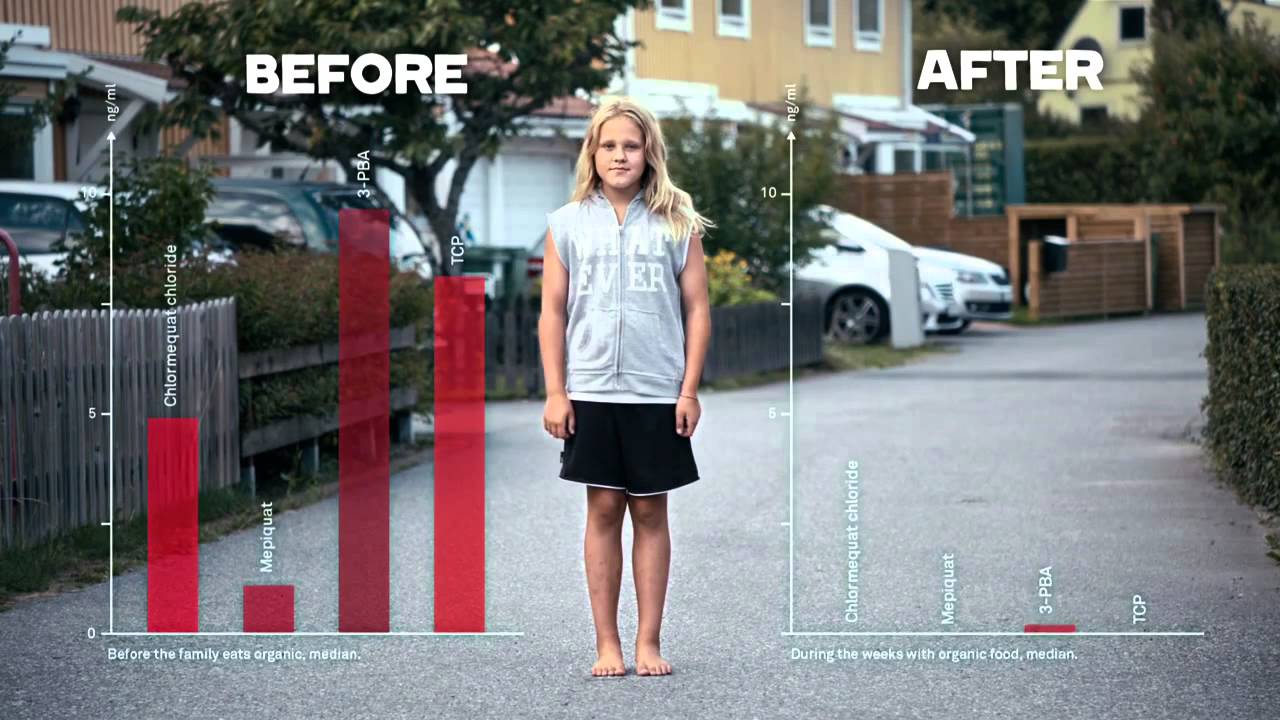
Family stops eating non organic food for a couple weeks and tests show that they detoxify greatly. The poisons sprayed on your food were never for bugs. They are simple lies so you ingest and inject the poison without resistance or question.
9 Likes
+plasma light and other goodies:)
3 Likes